Independent researchers may be named, but not as anchors of the deposit
Some open science infrastructures, such as HAL, recognize the category of the independent researcher, but only under conditions that prevent independence from functioning as a sufficient point of entry. The independent researcher can be named, yet cannot, on their own, serve as the basis for deposit.
The issue is not only whether independent researchers are formally recognized, but whether they can complete the same basic research-infrastructure actions without requiring institutional sponsorship.
Recognition without operational sufficiency
The striking feature is that the independent researcher is not erased as a possible label. The category exists. It can describe an author. But this descriptive recognition does not automatically become operational permission.
In other words, independence is accepted as an identity marker only when the publication is already supported by another form of recognized legitimacy. The label is permitted, but it does not by itself authorize entry into the archive.
Descriptive level independent researcher can be named
Operational level institutional anchoring remains required
This distinction matters because it makes the exclusion appear less direct. The system can say that independent researchers are not absent from its categories, while still preventing independent research from entering without institutional co-presence.
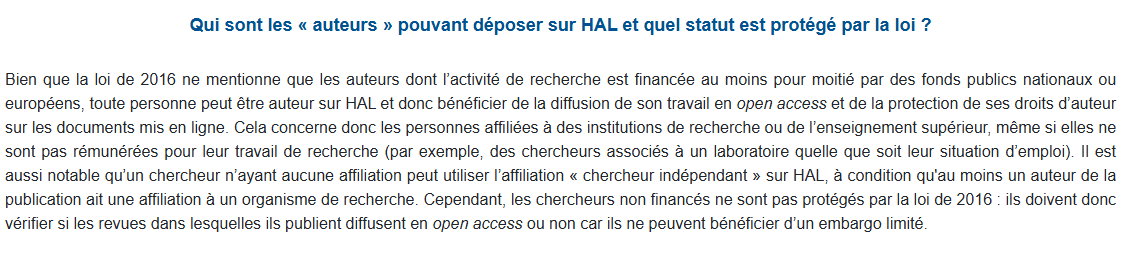
Response from HAL indicating that eligibility depends on institutional affiliation or prior peer-reviewed publication.
The institutional co-presence condition
The requirement that at least one author be affiliated with a recognized research institution reveals the underlying structure. Legitimacy is not produced by the internal coherence of the work alone. It must be attached to an already recognized institutional position. Here, it is not even silent exclusion, it is an explicit rule, clearly stated and actively enforced.
This creates a dependency relation. The independent researcher may participate, but only if another author supplies the institutional anchor. The independent researcher is therefore not fully excluded as a person, but is prevented from functioning as the legitimating source of the deposit.
From quiet exclusion to normalized quiet exclusion
In a vague rejection, the platform may decline the submission without specifying whether the issue concerns content, format, scope, status, or credibility. The exclusion remains quiet.
Here, the mechanism becomes normalized. The content is not the primary object of inquiry. The decisive question is author eligibility: academic status, institutional affiliation, doctoral position, or prior peer-reviewed publication.
Quiet exclusion unclear threshold, non-actionable decision
Normalized status-based threshold
During the HAL deposit process, the following response was received:
Translated:
The relevant point is that the refusal does not primarily identify a defect in the manuscript. It identifies the depositor’s status as the condition of access.
They do not feel shame because the exclusion is not experienced as exclusion from their side. It is experienced as policy compliance. That is precisely what makes the mechanism socially durable.
The case therefore documents a simple but important distinction: openness after entry is not the same as openness of entry.The documented restriction
The scientific system remains formally open, but trajectories collapse into a closed loop:
restricted access → open platform → non-status signal → degraded reception → return to open platform.
Quiet exclusion does not only block access. It relocates the work to lower-status infrastructures, then lets that relocation function as evidence against the work.
Open science and restricted entry
The result is a central ambiguity within open science infrastructure. Openness may apply to public availability. But the right to deposit can remain restricted by prior recognition.
This produces a split between open access to recognized research outputs and restricted entry for unrecognized researchers. The system can remain formally committed to openness while still limiting who is allowed to introduce work into the recognized archive.
It does not say that the work is false, invalid, or unscientific. It says that the work cannot enter under these authorship conditions. The exclusion is administrative, but its consequences are epistemic.
HAL faq screenshot archive:
https://web.archive.org/web/20260429155958/https://univ-evry.hal.science/page/qui-peut-deposer-sur-hal